
Clearing the UPSC Civil Services Examination is one of the most celebrated moments in any aspirant’s life. Years of preparation, sacrifices, and relentless focus come down to a single result. But the moment the final list is published, a new chapter begins, one that most aspirants know very little about.
The journey from clearing UPSC to becoming a working IAS officer is not immediate. It involves multiple stages: document verification, medical examination, service and cadre allocation, and a structured training program at a national academy. Only after completing all of these does an officer take charge of an actual posting.
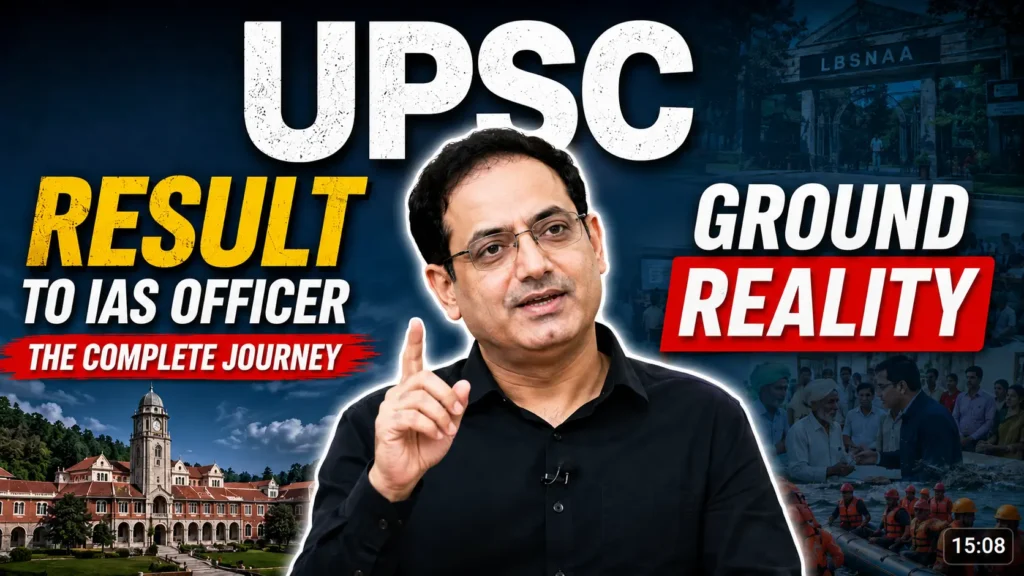
This blog covers every step of that journey in detail, from the day the UPSC final result is declared to the first field posting, salary structure, career growth, and the reality of life as an IAS officer.
Understanding the UPSC Final Result Process
The UPSC final merit list is published after the completion of the Personality Test (Interview). This list ranks every successful candidate based on their combined performance in the Mains written examination and the interview round.
The rank in this list determines everything that follows, including which service a candidate is allocated to. UPSC offers over 20 central services through this examination, including the IAS, IPS, IFS (Indian Foreign Service), IRS (Income Tax), IRS (Customs and Indirect Taxes), ICAS, and several others.
Once the final result is published, here is what happens step by step:
- Candidates receive official communication from UPSC and DoPT
- Document verification is conducted to confirm eligibility
- A medical fitness examination is carried out
- Service preference forms are submitted through the DoPT portal
- Service allocation is finalized based on rank, preferences, and available vacancies
- Cadre allocation (for IAS) happens next, followed by joining instructions
UPSC Service Allocation: How Rank Decides Your Career Path
Service allocation is the process by which a candidate is assigned to a specific central service. Three factors govern this entirely:
- The candidate’s rank in the UPSC final merit list
- The number of vacancies available in each service for that cycle
- The service preferences submitted by the candidate
The system works like a preference-matching exercise. Candidates fill out a ranked order of services they want, and the actual allocation is decided by matching these preferences against available vacancies in order of rank.
A candidate ranked in the top 100 typically qualifies for the IAS. As rank numbers increase, available options narrow. By the time you reach ranks beyond 500 or 600, the IAS and IPS may already be fully allocated, and the candidate is assigned to other services like IRS, ICAS, or others.
Approximate service allocation range (indicative, based on recent trends):
| Service | Approximate Rank Range | Category |
| IAS (Indian Administrative Service) | Top ~180 (General) | Group A |
| IPS (Indian Police Service) | ~180 to ~350 (General) | Group A |
| IFS (Indian Foreign Service) | ~100 to ~200 (General) | Group A |
| IRS – Income Tax | ~350 to ~600 (General) | Group A |
| IRS – Customs & Indirect Taxes | ~400 to ~650 (General) | Group A |
| ICAS / Other Central Services | ~600 and above | Group A / B |
Note: These figures are indicative and vary each year based on total vacancies notified by UPSC. Reserved category candidates have separate vacancies, so the effective rank within one’s category matters as much as the overall rank.
Aspirants who are also preparing for state-level exams should read our guide on UPPSC PCS Syllabus 2026 to understand how state service allocation compares to UPSC.
| Service | Power | Field Work | Prestige |
|---|---|---|---|
| IAS | ★★★★★ | ★★★★★ | ★★★★★ |
| IPS | ★★★★★ | ★★★★★ | ★★★★★ |
| IFS | ★★★★ | ★★ | ★★★★★ |
| IRS | ★★★ | ★★★ | ★★★★ |
IAS Officer Training Process at LBSNAA: What to Expect
The Lal Bahadur Shastri National Academy of Administration (LBSNAA), located in Mussoorie, Uttarakhand, is the premier training institution for IAS officers. Every probationer spends a significant portion of their first two years at this residential academy.
The training at LBSNAA is divided into clearly defined phases, each with a distinct purpose.
Phase 1: Foundation Course (3 Months)
This is a joint training program where officers from all central services, IAS, IPS, IFS, IRS, and others, train together. The Foundation Course focuses on:
- The Indian Constitution and governance structure
- Public administration principles
- Economic policy and national development
- Disaster management and emergency response
- Public service values and ethics
Phase 2: IAS-Specific Training at LBSNAA
After the Foundation Course, IAS probationers undertake Phase I training exclusively for the IAS batch. This phase combines academic sessions with outdoor activities, including horse riding, physical fitness drills, trekking, and cultural programs. Academic topics range from public finance and land laws to governance reforms and constitutional law.
Phase 3: District Training (Approximately 12 Months)
This is the most important phase of the training. The probationer is attached to a district in their allocated state cadre and works directly under the supervision of experienced senior IAS officers. Activities during district training include:
- Attending revenue courts and understanding land records
- Visiting rural areas and interacting with beneficiaries of government schemes
- Assisting the District Collector in law and order situations
- Observing disaster relief operations
- Managing sub-divisional administrative work
Phase 4: Return to LBSNAA and State Training
After district training, probationers return to LBSNAA for Phase II training, followed by a brief period with the state government. The entire training cycle runs to approximately two years. Only after this is the officer formally confirmed as an IAS officer and given an independent charge.
IAS Cadre Allocation: How Are IAS Officers Posted to States?
Cadre allocation is different from service allocation. While service allocation determines which service you join, cadre allocation determines which state you will serve in for most of your career.
India is divided into 26 IAS cadres. These include individual state cadres like Maharashtra, Tamil Nadu, and Uttar Pradesh, along with joint cadres such as:
- Assam-Meghalaya
- Manipur-Tripura
- AGMUT (Arunachal Pradesh, Goa, Mizoram, and Union Territories)
Under the current cadre allocation policy, a portion of seats in each cadre are filled by candidates from the same home state. The remaining seats are allocated to candidates from outside that state. This approach balances local familiarity with the national character of the IAS.
Candidates can state their cadre preferences, but the final allocation depends on rank, home state, and seat availability. Top-ranked candidates generally secure their preferred cadre. Once allocated, the cadre becomes the officer’s home for their career, though central deputation allows officers to work with the Government of India in New Delhi for fixed periods.
IAS First Posting: Roles, Responsibilities and Real Challenges
After training, a newly minted IAS officer receives their first independent posting. This is typically at the sub-divisional level, either as a Sub-Divisional Magistrate (SDM) or as an Assistant Collector working under a senior District Collector.
Over time, the officer progresses to handling an entire district as the District Magistrate (DM) or Collector. The District Magistrate is one of the most powerful and consequential administrative roles in India.
Key Responsibilities at the District Level
- Revenue administration: land records, mutations, and tenancy disputes
- Law and order maintenance in coordination with the district police
- Coordination and monitoring of central and state government welfare schemes
- Election management during local body, state, and general elections
- Disaster relief and rehabilitation operations
- Grievance redressal through public hearings (Jan Sunwai)
- Coordination with elected representatives and panchayat bodies
The first posting is demanding. Days begin early and often end late. Field visits to villages, revenue courts, departmental meetings, and unplanned emergencies — floods, riots, infrastructure failures — are all part of the job. But this phase is also described by most officers as the most fulfilling part of their career, because the impact is direct and visible.
IAS Officer Salary After UPSC: Pay Scale, Perks and Benefits
The salary of an IAS officer is governed by the 7th Pay Commission framework. Pay is organized into levels, and officers move up these levels as they earn promotions over the years.
A newly joined IAS officer starts at Pay Level 10, which carries a basic pay of Rs. 56,100 per month. Beyond basic pay, officers receive:
- Dearness Allowance (DA) — revised twice a year
- House Rent Allowance (HRA) — varies by city category
- Travel Allowance (TA)
- Medical benefits for self and family
The total monthly compensation at entry level typically ranges from Rs. 80,000 to Rs. 1,00,000 or more, depending on posting location and applicable allowances.
| Pay Level | Post | Basic Pay (per month) | Approx. Total Compensation |
| Level 10 | SDM / Assistant Collector | Rs. 56,100 | Rs. 80,000 – 1,00,000 |
| Level 12 | Deputy Secretary / Collector | Rs. 78,800 | Rs. 1,10,000 – 1,30,000 |
| Level 13 | Joint Secretary (State) | Rs. 1,18,500 | Rs. 1,60,000 – 1,80,000 |
| Level 15 | Additional Secretary | Rs. 1,82,200 | Rs. 2,20,000+ |
| Level 17 | Secretary, Govt. of India | Rs. 2,25,000 (Fixed) | Rs. 2,50,000+ |
Note: Figures are approximate and subject to revision based on DA revisions and individual posting location.
Non-Monetary Benefits
Beyond the salary, IAS officers receive a substantial package of perquisites that significantly enhance the overall value of the position:
- Government-provided accommodation (Type V to Type VIII bungalows depending on seniority)
- Official vehicles with driver
- Domestic staff (orderlies/peons as per entitlement)
- Comprehensive medical facilities for self and dependents
- Security personnel (in certain postings)
- Pension under the National Pension System (NPS)
IAS Promotion Hierarchy: Career Growth After Clearing UPSC
The IAS follows a structured promotion hierarchy based on years of service and performance evaluation through Annual Performance Appraisal Reports (APARs). Promotions are not purely automatic — exceptional and average performers can see different trajectories.
| Career Stage | Approximate Service Years | Typical Roles |
| Junior Scale | 0 to 4 years | SDM, Assistant Collector, Block Development Officer |
| Senior Time Scale | 4 to 9 years | District Collector, Additional Secretary (State) |
| Junior Administrative Grade | 9 to 13 years | Joint Secretary (State), Central Deputation |
| Selection Grade | 13 to 16 years | Principal Secretary (State), Joint Secretary (Centre) |
| Super Time Scale | 16 to 24 years | Additional Chief Secretary, Additional Secretary (Centre) |
| Apex Scale | 25+ years | Chief Secretary (State), Secretary to Govt. of India |
Central Deputation
At the junior administrative or selection grade stage, many IAS officers opt for central deputation. This means they work with a central government ministry in New Delhi for a fixed tenure (usually two to three years) before returning to their state cadre. Roles at the Centre include Deputy Secretary, Director, and Joint Secretary in various ministries.
Central deputation is considered valuable for exposure to national-level policy work and often opens pathways to senior positions in both the state and central governments.
If you are still in the preparation stage and want to build a strong foundation, our complete guide on How to Prepare for UPSC 2027 from Zero Level walks you through exactly where to start and how to build your strategy step by step.
Life After Clearing UPSC: A Day in the Life of an IAS Officer
A common misconception is that life as an IAS officer is glamorous and low on pressure. The reality is quite different. The day of a district-level IAS officer is long, unpredictable, and often intense.
A Typical Day at the District Level
- Early morning: Review of reports from blocks, tehsils, and government departments
- Field visits: Inspecting construction of public infrastructure, schools, or health centers
- Revenue courts: Hearing land disputes and passing orders
- Meetings: Coordination with Block Development Officers, line department heads, and elected representatives
- Jan Sunwai: Public hearings where citizens can directly raise grievances
- Evening reviews: Checking on scheme implementation data, preparing reports for state government
At the Secretariat Level
As officers move up in seniority and take on roles in state or central secretariats, the nature of work shifts from field administration to policy drafting, budget preparation, inter-departmental coordination, and liaison with the legislature. The pace remains demanding but the setting is more office-oriented.
Transfers happen every two to three years on average, moving officers across districts, departments, and even states (during central deputation). This variety means no two years in an IAS career are exactly alike.
UPSC Rank vs Service Allocation: What Every Aspirant Should Know
One of the most common questions among serious UPSC aspirants is how exactly a rank translates into service allocation. Understanding this can help set realistic targets and plan preparation accordingly.
UPSC does not publicly release a fixed rank cutoff for each service. The allocation depends on:
- Total vacancies notified in each service for that exam cycle
- Preferences submitted by all qualified candidates
- The rank of each candidate relative to all others
For example, if 180 IAS seats are available and a candidate ranks 175 with IAS as their first preference, they will likely receive the IAS allocation. But if only 150 seats are available that year, rank 175 may fall to IPS or the next preferred service.
This is why tracking previous year service allocation trends is important. Most serious aspirants study the last five years of service-wise cutoff data to gauge where a particular rank is likely to land.
Category-wise allocation also matters significantly. SC, ST, OBC, and EWS candidates have separate vacancies within each service. A candidate’s effective rank within their category can be the deciding factor.
For aspirants working on their answer writing and strategy, our article on UPSC Rote Learning vs Understanding: The Right Mains Answer Writing Strategy provides practical guidance that can directly impact your Mains performance and, consequently, your rank.
What If You Clear UPSC But Do Not Get IAS? Other Service Options
Clearing UPSC does not automatically mean getting the IAS. Depending on your rank, you may be allocated to the IPS, IFS, IRS, or another Group A Central Service. Each of these is a prestigious and well-compensated career in its own right.
| Service | Work Domain | Key Appeal |
| IPS (Indian Police Service) | Law enforcement, intelligence, security forces | Command authority, national security work |
| IFS (Indian Foreign Service) | Diplomacy, foreign policy, international affairs | Global exposure, representation of India abroad |
| IRS – Income Tax | Tax administration, investigations, policy | Financial domain expertise, anti-evasion work |
| IRS – Customs & Indirect Taxes | Trade facilitation, customs regulation, GST | Economic and trade policy interface |
| ICAS (Indian Civil Accounts Service) | Government accounting and financial management | Detailed public finance exposure |
Many officers who join IPS or IFS describe their service as equally fulfilling and, in some respects, more specialized than the IAS. The choice of service should not be seen as a consolation but as a distinct career path with its own rewards.
Where to Find Official Information About IAS Training and Allocation
For the most accurate and current information on LBSNAA training schedules, cadre allocation policy, and post-selection procedures, aspirants should refer to the following official sources:
1. Department of Personnel and Training (DoPT): dopt.gov.in — the nodal ministry for IAS allocation and service rules.
2. UPSC Official Website: upsc.gov.in — for final result notifications, service vacancy details, and official announcements.
Frequently Asked Questions
1. What happens immediately after clearing the UPSC exam?
After the final result is published, selected candidates undergo document verification and a medical fitness examination. They then submit service preferences online through the DoPT portal. Service and cadre allocation follows before joining instructions are issued.
2. How long does IAS officer training take after UPSC selection?
The complete training cycle takes approximately two years. This includes the three-month Foundation Course, Phase I and Phase II training at LBSNAA in Mussoorie, and around twelve months of district-level field training in the allocated state cadre.
3. What is the starting salary of an IAS officer?
A newly appointed IAS officer starts at Pay Level 10 under the 7th Pay Commission, with a basic pay of Rs. 56,100 per month. With Dearness Allowance, House Rent Allowance, and other allowances, the total monthly package typically ranges between Rs. 80,000 and Rs. 1,00,000 at the entry level.
4. How is IAS cadre allocation different from service allocation?
Service allocation decides which central service a candidate joins — such as IAS, IPS, or IFS. Cadre allocation, applicable only to IAS officers, decides which state the officer will serve in. Both happen as separate steps after the UPSC final result, with cadre allocation following service allocation.
5. What are the main responsibilities of an IAS officer in their first posting?
At the sub-divisional or district level, an IAS officer handles revenue administration, law and order management, implementation of government schemes, public grievance redressal, election management, and disaster response. The first posting is one of the most learning-intensive phases of the career.
6. What is the highest position an IAS officer can reach?
The highest position in the state cadre is Chief Secretary of a state. At the central level, the most senior position is Cabinet Secretary, which is the top civil service post in India. Reaching these positions typically requires 30 or more years of service with consistently strong performance records.
7. Can an IAS officer work at the central government level?
Yes. IAS officers from state cadres can go on central deputation and serve in central government ministries as Deputy Secretary, Director, Joint Secretary, Additional Secretary, or Secretary. Central deputation typically lasts two to three years before the officer returns to their state cadre.
Conclusion
Clearing the UPSC Civil Services Examination is a remarkable achievement. But the journey that begins after clearing it is equally significant and, in many ways, even more demanding. From LBSNAA training to the first district posting, from managing development programs to responding to natural disasters, the IAS is a career defined by constant learning, public responsibility, and real-world impact.
Understanding what comes after the result — the allocation process, the training, the salary, and the actual work — helps aspirants see the full picture before they commit to the path. And for those already on the journey, knowing what to expect after success can be a powerful source of motivation.
For more guides on UPSC preparation strategy, topper insights, and career planning, visit the UPSC section on SD Research World.
 Alok
Alok