
On May 24, 2026, over six lakh candidates appeared for UPSC Civil Services Preliminary Examination 2026. By the time both papers ended, one reaction was everywhere: the paper was unusually tough.
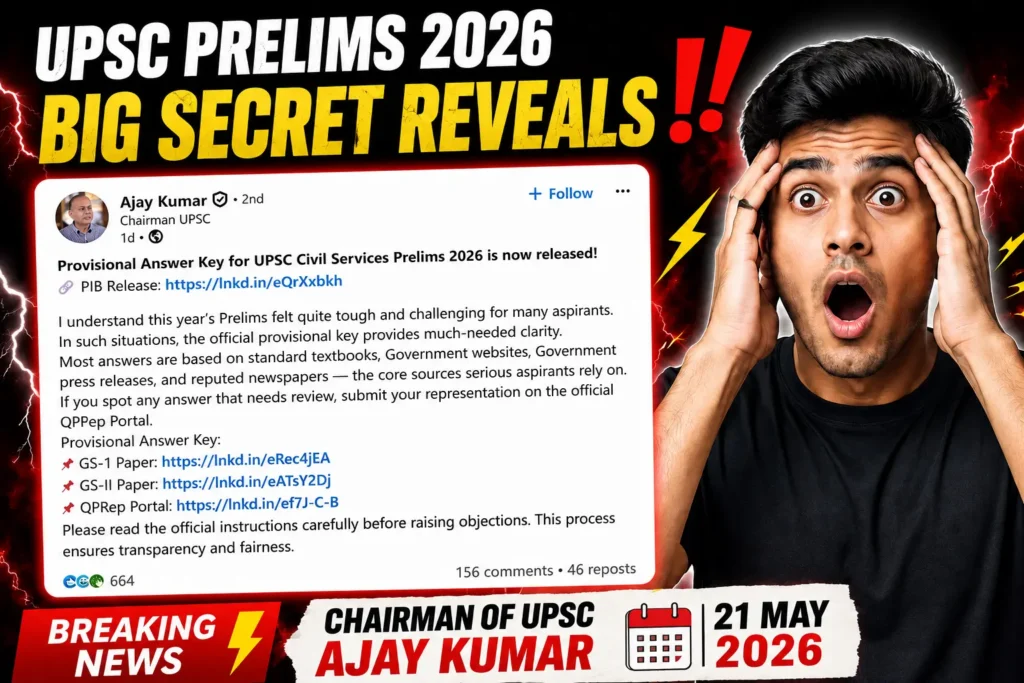
GS Paper 1 was longer and more analytical than recent years. Many candidates said questions felt unfamiliar despite months of preparation. Within days, UPSC Chairman Dr. Ajay Kumar responded publicly. He addressed the difficulty directly, confirmed which sources the questions came from, and announced something unprecedented: a provisional answer key released immediately after the exam, with a formal objection window through the QPRep portal.
This article covers everything you need to know why the paper was hard, what the Chairman said, how the provisional answer key process works, what the expected cutoff looks like, and what to do before the May 31 deadline.
Why Was UPSC Prelims 2026 So Tough? Chairman Ajay Kumar Explains
Dr. Ajay Kumar did not deny the difficulty. He acknowledged it openly but made one thing clear: a difficult paper is not an unfair paper. The questions were not drawn from obscure sources. They came from standard textbooks, official government releases, and reputed national newspapers — the same materials every serious aspirant is expected to study.
What changed was the depth of reasoning required. Knowing a fact was no longer enough. You had to understand the context behind it, work through multi-statement questions, and eliminate plausible-sounding wrong options. That is what made the paper feel harder, even for well-prepared candidates.
UPSC Chairman Ajay Kumar Statement 2026: What He Said About Prelims
Dr. Ajay Kumar’s statement addressed three things. First, he confirmed the paper was challenging and said rigor is expected at this level. Second, he clarified that every question was drawn from verified sources and was within the UPSC syllabus. Third, he announced the provisional answer key and the QPRep portal, inviting candidates to challenge any answer before May 31, 2026.
His tone was professional and measured. The message: the difficulty was intentional, the sources were credible, and a transparent correction process is now in place. For the full subject-wise breakdown of what appeared in the paper, see the UPSC Prelims 2026 Exam Analysis on SD Research World.
What Did the UPSC Chairman Post on Social Media?
Dr. Ajay Kumar posted on LinkedIn after the exam to communicate directly with aspirants. He explained that UPSC is not testing candidates who have memorized content, it wants candidates who can connect information, draw conclusions, and apply understanding to unfamiliar scenarios.
The post also announced the provisional answer key and QPRep portal details. For the first time, UPSC was communicating openly with candidates about the process rather than announcing results in silence.
Which Sources Did UPSC Prelims 2026 Questions Come From?
The Chairman identified three specific source categories.
1. Standard Textbooks
Core subject questions came from standard textbooks already on every aspirant’s list: NCERT books from Class 6 to 12, and reference books in Polity, History, Geography, and Economy. The foundation has not changed.
2. Government Websites and PIB Press Releases
Several analytical questions were drawn from official government websites and PIB, the Press Information Bureau. PIB publishes daily press releases on government schemes, policy decisions, and official data. The Chairman’s specific mention of PIB is a strong signal: if you are not reading it daily, you are missing one of UPSC’s primary source banks.
3. Reputed National Newspapers
Current affairs questions came from established national newspapers. The Hindu and The Indian Express are the most referenced in UPSC circles, and the Chairman’s statement aligns with this. Editorial analyses, science coverage, and policy reporting from these papers are clearly within UPSC’s scope.
Standard Books for UPSC Prelims: What the Chairman’s Statement Points To
If you are preparing for UPSC 2027, here is the subject-wise reading list the Chairman’s confirmed sources point toward.
| Subject | Primary Book / Source | Why It Matters |
| Polity | M. Laxmikanth | Statement-based questions demand conceptual depth; every chapter counts |
| Modern History | Spectrum by Rajiv Ahir | Freedom movement, reforms, institutional history |
| Ancient/Medieval History | Old NCERT Class 11-12 | Ancient History surged to 9 questions in 2026; Medieval had zero |
| Art and Culture | Nitin Singhania | 6 questions in 2026 after near-absence in 2025 |
| Geography | NCERT Class 11-12 + Atlas | Physical Geography NCERT essential; World Geography dropped to just 2 questions |
| Economy | Ramesh Singh + Economic Survey | Budget, fintech, banking; Mrunal Patel notes popular for simplification |
| Environment | Shankar IAS Environment | 7 questions in 2026; ecosystem and climate policy coverage |
| Science and Tech | Ravi Agrahri + Newspapers | Space, AI, defence tech; newspaper science pages equally important |
| Current Affairs | The Hindu / Indian Express + PIB | 30 questions in 2026 — now a primary subject, not supplementary |
Why PIB and Government Sources Matter More Than Ever
PIB publishes daily releases covering central government schemes, policy changes, and official data. These contain exact figures, timelines, and objectives that UPSC uses directly for question framing. Ministry annual reports from Finance, Environment, Science and Technology, and NITI Aayog also feature regularly. The Economic Survey, published each year before the Union Budget, is a primary document every UPSC aspirant must read.
NCERT books reflect this policy-connected approach. The Class 12 Political Science NCERT connects federalism to current constitutional debates. The Class 11 Biology NCERT covers environmental concepts that appear directly in the paper. NCERTs are not just for fundamentals, they build the conceptual base that connects to current policy.
No Paper Leak: What the Chairman Clarified
After the exam, some candidates speculated about irregularities. The Chairman addressed this directly: there was no paper leak. The examination process was sound. What changed was the analytical depth expected, not the integrity of the paper.
Think of it this way: a cooking exam that always asked ‘what is the boiling point of water’ suddenly asked ‘why does water boil faster at higher altitudes?’ Same source, different depth of thinking required. That is what happened in 2026.
For aspirants targeting 2027, the complete UPSC 2027 preparation guide from zero level covers how to build an understanding-first approach that handles this kind of analytical paper.
UPSC Provisional Answer Key 2026: Why This Is a Historic First
For the first time in UPSC history, a provisional answer key was released immediately after the exam. Previously, candidates had no way to verify individual answers before the final result and had to rely entirely on unofficial coaching institute keys with no formal challenge mechanism.
Now, candidates can compare their responses against UPSC’s current answers and formally challenge any answer through the QPRep portal. UPSC will review each objection with subject experts. If valid, the final key is revised before result calculation. This is a genuine improvement in transparency and fairness, and Chairman Dr. Ajay Kumar framed it as a trust-based reform.
How to Raise an Objection on the QPRep Portal: Step-by-Step
- Step 1: Go to upsc.gov.in and find the link for the QPRep Portal or CSP 2026 Answer Key, usually on the homepage.
- Step 2: Log in with your registration number and date of birth.
- Step 3: Select GS Paper 1 or CSAT Paper 2, then choose the specific question number.
- Step 4: State the answer in the key, the answer you believe is correct, and provide a justification with a credible source.
- Step 5: Submit before 6:00 PM on May 31, 2026 on the official UPSC website. The portal closes after the deadline with no extensions.
UPSC Prelims 2026 Key Dates at a Glance
| Date / Event | What It Means |
| May 24, 2026 | UPSC Prelims 2026 held across India |
| Within days of exam | Provisional answer key released — first time in UPSC history |
| May 31, 2026, 6:00 PM | Final deadline to submit objections on QPRep portal |
| After May 31 | UPSC reviews objections; final key revised if needed |
| Expected mid-June 2026 | Prelims result declared on upsc.gov.in as roll number list |
UPSC Prelims 2026 GS Paper 1: What Was Different This Year
Questions were longer. In past years, questions fit in two or three lines. Several in 2026 ran to half a page. Parsing the question alone used significant time.
The subject mix was unpredictable. Current Affairs doubled from 15 to 30 questions. Ancient History surged from 4 to 9. Medieval History disappeared entirely with zero questions. World Geography dropped from 13 to 2. No conventional strategy accounted for these shifts.
Language was denser. Several questions were layered and complex in phrasing. Identifying what was being asked took real effort.
The overall signal from 2026 is clear: UPSC is rewarding understanding over coverage, and current affairs is now a primary subject. Aspirants preparing for 2027 must plan around this as the new standard.
UPSC Prelims 2026 Expected Cutoff: Category-Wise Estimates
Because GS Paper 1 was harder than 2025, experts expect the cutoff to be slightly lower. Here is the estimated range.
| Category | Expected Cutoff 2026 | Actual Cutoff 2025 (Approx) | Direction |
| General | 80 to 95 marks | ~100 marks | Lower |
| OBC | 78 to 92 marks | ~96 marks | Lower |
| SC | Comparatively lower | ~82 marks | Lower |
| ST | Comparatively lower | ~77 marks | Lower |
Note: These are expert estimates based on paper difficulty and historical trends. The official cutoff is published by UPSC only after the final merit list.
The objection review process adds uncertainty: revised answers can shift final scores across the board. If you scored around 80 to 95 on the provisional key, do not draw conclusions yet. Raise valid objections, wait for the final key, and use the UPSC Marks Calculator to get a precise score estimate. Do not stop Mains preparation.
How to Check the UPSC Prelims 2026 Answer Key in Hindi
UPSC releases the official answer key in English, but question papers are available in both languages with identical question numbering. To check in Hindi: download both the Hindi question paper and provisional answer key from upsc.gov.in. The key shows option letters (A/B/C/D); the question paper shows full Hindi text for each option. Use both together to verify your answers.
If you find a discrepancy, submit your objection through the QPRep portal before May 31 at 6:00 PM. For organizing Mains preparation after Prelims, the post on how to use UPSC topper notes subject-wise is a useful next step.
Frequently Asked Questions
Q1. What did UPSC Chairman Ajay Kumar say about Prelims 2026?
He confirmed the paper was difficult but drawn from standard textbooks, PIB press releases, and reputed newspapers. He released the provisional answer key and invited objections through the QPRep portal before May 31, 2026.
Q2. Which sources did UPSC Prelims 2026 questions come from?
Three sources: standard textbooks (NCERTs and reference books), official government websites and PIB press releases, and reputed national newspapers such as The Hindu and The Indian Express.
Q3. Why was UPSC Prelims 2026 so tough?
Questions required analytical reasoning rather than factual recall. They were longer, statement-based, and drew from applied areas including space technology, fintech, and UN frameworks. Time management was also a challenge.
Q4. Why did UPSC release a provisional answer key for the first time?
It is a transparency reform under Dr. Ajay Kumar. Candidates can now verify answers and formally challenge errors before the final result is calculated. UPSC reviews each objection with subject experts.
Q5. How do I raise an objection on QPRep? What is the deadline?
Log in to upsc.gov.in with your registration number and date of birth. Select the question, state your reasoning with a credible source, and submit. Deadline: May 31, 2026 at 6:00 PM. No extensions.
Q6. What is the expected cutoff for General category in UPSC Prelims 2026?
Experts estimate 80 to 95 marks, lower than 2025’s ~100 marks. This is not official. The actual cutoff depends on vacancies, total candidates, and the final revised answer key.
Q7. How do I check the answer key in Hindi?
Download the Hindi question paper and the provisional answer key from upsc.gov.in. Match option letters by question number. The question paper has the full Hindi text of each option.
 Alok
Alok