
Preparing for UPSC is one of the most serious commitments a student can make. Years of effort, long study hours, and enormous patience go into it. But here is a question that many aspirants quietly ask themselves: What if UPSC does not work out this year? Or the next year?
That is not a pessimistic thought. That is a practical one.
UPSC has a fixed number of seats every year, and lakhs of candidates compete for them. Having a strong backup plan does not mean giving up. It means being smart about your career. The good news is that UPSC preparation genuinely overlaps with many other competitive exams, so your hard work is never wasted.
This guide covers which exams you can give alongside UPSC in 2026, why they make sense, and how to prepare for both without losing focus on your main goal.
Why Do UPSC Aspirants Need a Backup Plan?
UPSC Civil Services is one of the toughest exams in India. Every year, roughly 10 to 13 lakh candidates appear for Prelims. Only about 1,000 finally get selected. That is a success rate of well under 1%.
Beyond that, UPSC gives you a limited number of attempts. General category candidates get 6 attempts, OBC candidates get 9, and all of this must happen before the age cutoff.
If you spend 4 to 5 years focused only on UPSC and it does not work out, you could find yourself with no government job and a gap that is hard to explain to employers. A backup plan solves this. It gives you a safety net that actually uses your UPSC preparation — because many exams test the same things UPSC does, such as General Studies, Current Affairs, and Analytical Reasoning.
Think of it this way. A cricket team does not field only its best batsman. It builds depth. You should build career depth too.
Which Exams Can You Take Along with UPSC Preparation?
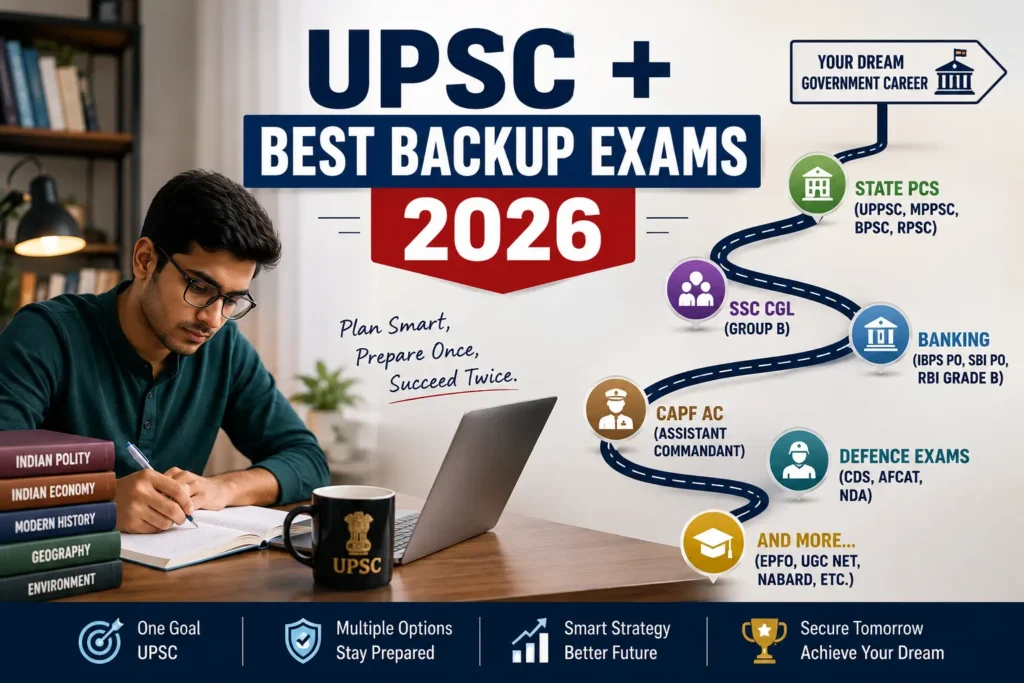
Here is a clear overview of the top exams that UPSC aspirants can realistically attempt alongside their main preparation:
- SSC CGL (Staff Selection Commission, Combined Graduate Level)
- State PCS Exams (UPPSC PCS, MPPSC, BPSC, RPSC, etc.)
- Banking Exams: IBPS PO, SBI PO, RBI Grade B
- CAPF AC (Central Armed Police Forces, Assistant Commandant)
- CDS (Combined Defence Services)
- AFCAT (Air Force Common Admission Test)
- NDA (National Defence Academy, for younger aspirants)
- EPFO Enforcement Officer (Employees Provident Fund Organisation)
- UGC NET (for teaching and research aspirants)
- NABARD Grade A and Grade B
Each of these has its own character. Some have very high syllabus overlap with UPSC. Others need only modest extra preparation. We will look at each category in detail.
Should You Prepare for SSC CGL Along with UPSC?
SSC CGL is one of the most popular government exams in India. It recruits for posts like Income Tax Inspector, Excise Inspector, Audit Officer, and many others across central government departments. The pay is decent, the job security is high, and the work-life balance is generally better than the private sector.
How Much Does the Syllabus Overlap?
SSC CGL tests General Awareness (which covers History, Geography, Polity, and Science), Quantitative Aptitude, English, and Reasoning. The General Awareness portion aligns well with what UPSC aspirants already study for GS Paper 1 and GS Paper 2.
However, SSC CGL puts heavier emphasis on Mathematics (Quantitative Aptitude) and Reasoning than UPSC does. UPSC aspirants who have not focused on these sections will need to put in targeted extra effort.
Should You Attempt It?
Yes, if you can spare 2 to 3 hours per week on Maths and Reasoning specifically. The exam is held throughout the year in phases (Tier 1, Tier 2, and Tier 3), so the scheduling is manageable. Many successful UPSC toppers cleared SSC CGL in the years before their final UPSC success. It keeps morale high and provides financial stability while you continue preparing.
Benefits of Appearing for State PCS Exams Alongside UPSC
State PCS exams such as UPPSC PCS, BPSC, MPPSC, and RPSC are the closest cousins of UPSC. They follow almost the same structure: a Prelims stage, a Mains stage with descriptive papers, and a Personality Test (Interview). The posts at stake are Deputy Collector, DSP, BDO, CDPO, and similar state-level administrative officers.
Why State PCS Makes Perfect Sense for UPSC Aspirants
The syllabus overlap is the highest of any exam category. If you are preparing for UPSC GS, you are already covering 80 to 90 percent of the State PCS syllabus. State-specific topics such as state history, state geography, and regional current affairs need a few extra weeks of focused study, but that is very manageable.
The selection process, exam pattern, and even the kind of thinking required are nearly identical. A student who has seriously prepared for UPSC Mains can write a very strong State PCS Mains answer as well.
State PCS selections also happen more frequently than UPSC, and the competition, while still tough, is less intense at the national level. For someone from Uttar Pradesh, giving UPPSC PCS alongside UPSC is almost a given.
If you want to understand the full UPPSC PCS exam pattern and syllabus, you can read this detailed guide: UPPSC PCS Syllabus 2026 in Hindi PDF.
How Useful Are Banking Exams (IBPS, SBI, RBI Grade B) for UPSC Aspirants?
| Exam | Overlap | Salary | Backup Score |
|---|---|---|---|
| State PCS | ⭐⭐⭐⭐⭐ | ⭐⭐⭐⭐ | 10/10 |
| CAPF AC | ⭐⭐⭐⭐⭐ | ⭐⭐⭐⭐ | 9/10 |
| SSC CGL | ⭐⭐⭐⭐ | ⭐⭐⭐ | 8/10 |
| RBI Grade B | ⭐⭐⭐ | ⭐⭐⭐⭐⭐ | 9/10 |
| IBPS PO | ⭐⭐ | ⭐⭐⭐ | 6/10 |
Banking exams occupy an interesting space for UPSC aspirants. Here is a breakdown by category.
RBI Grade B
This is the most relevant banking exam for UPSC aspirants. RBI Grade B Phase 1 tests General Awareness, English, Quantitative Aptitude, and Reasoning. Phase 2 includes papers on Economics and Social Issues, English Writing Skills, and Finance and Management.
The Economics paper is particularly well-aligned with UPSC GS Paper 3. If you have studied Indian Economy, monetary policy, inflation, and fiscal policy for UPSC, a significant portion of that effort directly carries over. The salary is approximately Rs. 14 to 17 lakh per year, and the post comes with genuine prestige.
IBPS PO and SBI PO
These exams test Reasoning, Quantitative Aptitude, English, and General Awareness. The General Awareness section overlaps with UPSC to a degree, but these exams are heavily speed-based, especially in Quantitative Aptitude and Reasoning. The salary of Rs. 6 to 8 lakh per year provides good financial stability, and the job security is solid.
The honest assessment: IBPS PO and SBI PO require dedicated practice for Maths and speed-based reasoning. If these are not your strengths, they need a few months of focused work. But the job security they offer makes the effort worthwhile.
CAPF, CDS, and AFCAT: Best Defence Exam Options for UPSC Aspirants
These three defence and paramilitary exams deserve special attention. They are genuinely underrated by the UPSC community.
CAPF AC (Central Armed Police Forces, Assistant Commandant)
CAPF AC is conducted by UPSC itself. The exam pattern is structured like UPSC, with a written exam (Paper 1 and Paper 2) followed by a Physical Test and Interview. Paper 2 is a general studies essay and comprehension paper that directly rewards UPSC-style thinking and writing.
For anyone preparing for UPSC, CAPF AC is the closest alternative exam. The posts are senior positions in forces like BSF, CRPF, CISF, ITBP, and SSB. The salary, perks, and career growth are all strong. If you are physically fit and motivated, this is a top backup choice.
CDS (Combined Defence Services)
CDS is also conducted by UPSC and recruits officers into the Indian Army, Navy, and Air Force. The written exam tests English, General Knowledge, and Elementary Mathematics. UPSC aspirants have a clear advantage in the General Knowledge section, which covers History, Geography, Polity, Economy, and Current Affairs.
The selection process includes the SSB (Services Selection Board) interview, which is rigorous but requires separate preparation. If you are open to a defence career, CDS is one of the best options available.
AFCAT (Air Force Common Admission Test)
AFCAT recruits officers into the Indian Air Force in Flying, Technical, and Ground Duty branches. The written exam is less GS-heavy than UPSC, but the general awareness and reasoning sections benefit from UPSC preparation. AFCAT is a good option for engineering graduates or those interested in a structured, high-discipline career.
Which Exam Syllabus Matches UPSC Preparation the Most?
UPSC Aspirant
↓
UPSC
↓
┌────────────┬─────────────┬────────────┐
│ State PCS │ SSC CGL │ RBI Grade B│
└────────────┴─────────────┴────────────┘
↓
Secure Government Career
Here is a structured comparison to help you see where your UPSC preparation is already working in your favour:
| Exam | Syllabus Overlap | Difficulty | Approx. Salary | Attempt Limit |
| SSC CGL | High (GS, Reasoning) | Medium | Rs. 7L–10L/yr | No Limit |
| State PCS | Very High (same pattern) | Medium-High | Rs. 8L–12L/yr | Varies by State |
| RBI Grade B | Medium (Economy, GS) | High | Rs. 14L–17L/yr | No Limit |
| IBPS PO | Low–Medium | Medium | Rs. 6L–8L/yr | No Limit |
| CAPF AC | High (GS, Current Affairs) | Medium-High | Rs. 9L–12L/yr | 4 Attempts |
| CDS | Medium (GS, English, Maths) | Medium | Rs. 9L–12L/yr | Varies |
| AFCAT | Low–Medium | Medium | Rs. 9L–12L/yr | No Limit |
The table above makes one thing clear: State PCS and CAPF AC give you the most direct return on your UPSC study effort. SSC CGL and RBI Grade B come next. Banking exams like IBPS PO require the most separate preparation but offer reliable government employment.
UPSC Backup Exams 2026: Top 10 Best Government Exams
Here is a ranked list of the best backup exams for UPSC aspirants in 2026, based on syllabus overlap, salary, job security, and career growth:
- UPPSC / State PCS Exam — Highest syllabus overlap, same exam pattern
- CAPF AC — Conducted by UPSC itself, strong GS component, excellent career
- RBI Grade B — Best banking option for UPSC aspirants, strong Economics overlap
- SSC CGL — High demand, good salary, strong GS overlap
- CDS — Defence career, GS-heavy, conducted by UPSC
- NABARD Grade A — Good for Rural Development and Economy focus students
- EPFO Enforcement Officer — Social Security and Labour Law, strong GS overlap
- IBPS PO and SBI PO — Reliable government banking job, moderate overlap
- AFCAT — Indian Air Force, structured career, discipline-oriented
- UGC NET — For aspirants open to academics and teaching, Polity and History overlap
UPSC and Backup Exam Strategy: How to Prepare for Both Together
This is where most aspirants struggle. They either go all-in on UPSC and ignore backups, or they scatter their preparation so widely that they do not do justice to either. Here is a realistic, practical approach.
Keep UPSC as Your Primary, Not Your Only
Your daily study schedule should still centre on UPSC. GS Papers, CSAT, Optional Subject, and Essay should get the lion’s share of your time, roughly 7 to 8 hours a day for a serious aspirant. The backup exam should get 1 to 1.5 hours a day, focused specifically on the gaps.
Choose Only One or Two Backup Exams
Trying to prepare for five exams simultaneously is a recipe for failing all five. Be honest about your core strengths. If you are strong in GS, CAPF AC or State PCS should be your natural backup. If you have a background in Economics or Finance, RBI Grade B makes sense. If you want to maximise job options quickly, SSC CGL with focused Maths practice is a pragmatic choice.
Use UPSC Current Affairs for All Exams
The single biggest efficiency hack here is this: your daily newspaper reading and monthly Current Affairs revision done for UPSC is directly useful for the General Awareness section of almost every exam on the list above. Do not do separate Current Affairs preparation for each exam. One focused reading habit covers multiple exams.
Time Your Attempts Smartly
UPSC Prelims is usually in May or June. CAPF AC is usually in August. SSC CGL Tier 1 rolls through the year. State PCS exams have their own calendars. Map out the exam dates at the start of the year and plan your backup-specific preparation to peak in the 6 to 8 weeks before each exam date.
For a complete understanding of how to approach UPSC preparation from the beginning, read: How to Prepare for UPSC 2027 from Zero Level.
January
↓
State PCS Forms
March
↓
SSC Preparation
May
↓
UPSC Prelims
August
↓
CAPF AC
September
↓
SSC CGL
November
↓
State PCS
If UPSC Does Not Select You: What Are Your Career Options?
This question deserves a calm, clear answer rather than a scary one.
Not getting selected in UPSC does not define your intelligence, your potential, or your worth. The competition is intense, and the selection involves significant elements of uncertainty, including the specific questions asked in Mains, how your Optional Subject performed in a given year, and the dynamics of the interview board.
By the time you have seriously prepared for UPSC, you have developed a genuinely valuable set of skills: the ability to read and synthesise large volumes of information, write structured analytical answers, understand governance, economy, and public policy, and stay self-disciplined over long periods. These are not small things.
Option 1: State PCS (If Not Already Cleared)
If you cleared Prelims or Mains once but not the final stage, State PCS is your most logical next step. The preparation is not wasted. The knowledge transfers almost entirely.
Option 2: Central Government Services via SSC or Banking
SSC CGL Group B and Group C posts, as well as IBPS PO or SBI PO, provide stable, well-paying central or public sector banking careers. Many former UPSC aspirants have built excellent professional lives in these roles.
Option 3: Teaching, Research, or Academic Roles
UGC NET qualifies you to become an Assistant Professor or a Junior Research Fellow. If you prepared for UPSC with History, Political Science, or Sociology as your Optional, you are already very well-positioned for NET in those subjects.
Option 4: Corporate Sector, Policy Research, or NGOs
UPSC preparation makes you a strong analyst and communicator. Policy research organisations, think tanks, NGOs focused on governance, and corporate roles in compliance, public affairs, and training actively value candidates with UPSC backgrounds.
A UPSC attempt is never wasted, even if you do not get selected. What you build in the process carries value across a wide range of careers. If you are curious about how toppers think and strategise, take a look at this resource:
UPSC Rote Learning vs Understanding: The Right Mains Answer Writing Strategy — it offers a practical lens on building the right preparation mindset.
Frequently Asked Questions (FAQs)
1. UPSC ke sath kaun kaun se exam de sakte hain?
Alongside UPSC, you can realistically attempt State PCS exams (UPPSC, BPSC, MPPSC), SSC CGL, CAPF AC, CDS, RBI Grade B, IBPS PO, AFCAT, NABARD Grade A, EPFO Enforcement Officer, and UGC NET. These all share significant syllabus overlap with UPSC preparation.
2. What are the best UPSC backup exam options in 2026?
The top three options are State PCS exams (highest syllabus overlap), CAPF AC (same conducting body as UPSC, similar pattern), and RBI Grade B (strong Economics and GS connection). For those comfortable with Maths, SSC CGL is also a strong fourth choice.
3. How do you prepare for both UPSC and SSC CGL together?
Keep your UPSC GS preparation as your foundation. Add 1 to 1.5 hours of Quantitative Aptitude and Reasoning practice daily for SSC CGL. Use the same Current Affairs preparation for both. Focus your SSC-specific effort on the Maths section, as that is where the syllabi diverge the most.
4. How beneficial is the State PCS exam for UPSC aspirants?
Very beneficial. State PCS exams follow almost the same structure as UPSC, test the same GS subjects, and even the Optional paper system is similar in several states. If you have seriously prepared for UPSC Prelims and Mains, you are already most of the way there for State PCS. The additional effort required is relatively small.
5. Is it wise to give banking exams alongside UPSC preparation?
Yes, with a caveat. RBI Grade B is the most aligned with UPSC because of its Economics and General Studies papers. IBPS PO and SBI PO require heavier preparation in Quantitative Aptitude and Reasoning. Both are worth attempting if you can spare dedicated preparation time, but do not let them come at the expense of your UPSC core preparation.
6. How do UPSC aspirants crack CAPF and CDS exams?
For CAPF AC, focus especially on Paper 2, which tests General Studies, Essay, and Comprehension. This is the area where UPSC preparation gives the strongest advantage. Start a structured physical fitness routine well in advance. For CDS, the General Knowledge paper is your strong suit from UPSC prep; Maths needs separate practice. SSB preparation for CDS is unique and requires at least 3 to 4 weeks of dedicated preparation for group discussions and psychological tests.
7. UPSC fail hone par kya kare? What are the best alternative career options?
If UPSC does not work out, your options include State PCS (highly recommended as a first move), SSC CGL, RBI Grade B or IBPS PO for banking careers, UGC NET for academic careers, and policy or research organisations that value UPSC-trained analytical thinking. Your preparation is not wasted. The skills you have built translate into real professional value across government, banking, and even private sector roles.
For official UPSC exam notifications and calendar, visit:
UPSC Official Website — upsc.gov.in.
[…] रहकर UPSC की तैयारी कर रहे हैं, तो हमारी Best Government Exams to Appear Along with UPSC Preparation गाइड भी आपके काम आएगी, जिसमें […]