
When you clear the UPSC Civil Services Examination, you do not just get one job. You get access to 23 different services, each with its own role, responsibilities, and career path. Many aspirants spend years preparing for UPSC, but very few take time to understand what each post actually involves.
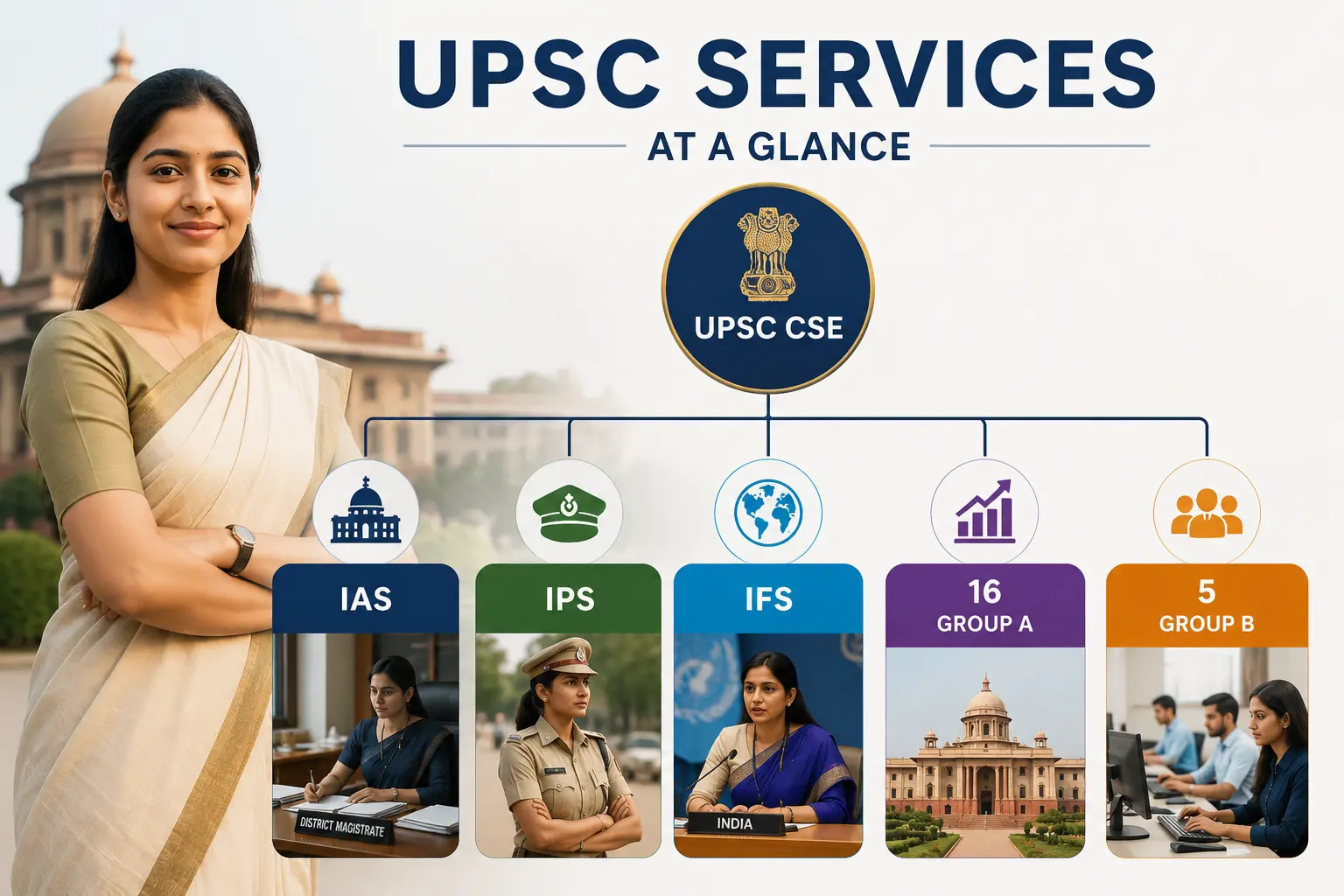
Knowing the UPSC posts list before you appear for the exam helps you fill your preference list wisely and set realistic career expectations. This article walks you through every service in the UPSC posts list 2026, explains what each one means, and helps you think about which direction suits your goals. If you are also preparing for the exam itself, check out our guide on the UPSC Exam Pattern 2026 to understand how the selection process works.
1. Complete UPSC Posts List 2026: Group A and Group B Services
The UPSC CSE selects candidates for three broad categories of services: All India Services, Group A Services, and Group B Services. Think of them as three tiers, with All India Services at the top in terms of prestige, jurisdiction, and career flexibility.
Here is the complete list of all 23 services covered under UPSC CSE 2026:
| Category | Service Name |
| All India Services | Indian Administrative Service (IAS) |
| All India Services | Indian Police Service (IPS) |
| Group A | Indian Foreign Service (IFS) |
| Group A | Indian Audit and Accounts Service (IA&AS) |
| Group A | Indian Civil Accounts Service (ICAS) |
| Group A | Indian Corporate Law Service (ICLS) |
| Group A | Indian Defence Accounts Service (IDAS) |
| Group A | Indian Defence Estates Service (IDES) |
| Group A | Indian Information Service (IIS) |
| Group A | Indian Postal Service (IPoS) |
| Group A | Indian P&T Accounts and Finance Service |
| Group A | Indian Railway Management Service — Traffic (IRMS) |
| Group A | Indian Railway Management Service — Personnel (IRMS) |
| Group A | Indian Railway Management Service — Accounts (IRMS) |
| Group A | Indian Railway Protection Force Service (IRPF) |
| Group A | Indian Revenue Service — Customs & Indirect Taxes (IRS-C&IT) |
| Group A | Indian Revenue Service — Income Tax (IRS-IT) |
| Group A | Indian Trade Service (Grade III) |
| Group B | Armed Forces HQ Civil Service (Section Officer’s Grade) |
| Group B | DANICS |
| Group B | DANIPS |
| Group B | Pondicherry Civil Service (PONDICS) |
| Group B | Pondicherry Police Service (PONDIPS) |
The final number of vacancies in each service is announced in the official UPSC notification and can vary from year to year. You can check the latest vacancy details directly at upsc.gov.in.
2. IAS, IPS, IFS and IRS: Full Form, Roles and Key Differences
These four services are the most talked about in the UPSC ecosystem. Here is a clear breakdown of what each actually does:
| Service | Full Form | Core Role | Ministry |
| IAS | Indian Administrative Service | District & state administration, policy implementation | Ministry of Personnel |
| IPS | Indian Police Service | Law enforcement, internal security, crime control | Ministry of Home Affairs |
| IFS | Indian Foreign Service | Diplomatic representation abroad | Ministry of External Affairs |
| IRS-C&IT | Indian Revenue Service | Customs and indirect tax administration | Ministry of Finance |
| IRS-IT | Indian Revenue Service | Income tax collection and enforcement | Ministry of Finance |
| Feature | IAS | IPS | IFS | IRS |
|---|---|---|---|---|
| Field Work | High | Very High | Low | Medium |
| Foreign Posting | No | No | Yes | Rare |
| Public Interaction | High | High | Medium | Medium |
| Transfers | Frequent | Frequent | International | Moderate |
The key difference is jurisdiction and function. IAS officers work across a wide range of administrative functions, from managing district budgets to advising state governments. IPS officers focus specifically on policing and public order. IFS officers are posted abroad and represent India in embassies and international forums. IRS officers deal with tax compliance, revenue collection, and financial enforcement.
All four are highly competitive and attract the top ranks in the UPSC merit list. If you want to understand how top rankers in previous years performed, our post on the UPSC Hindi Medium Topper List 2025 gives a detailed view of their strategies and scores.
3. UPSC Group A Services Explained for Beginners

Group A services are central government services where officers work directly under the Union Government. These are gazetted posts, meaning the government officially publishes the appointment. Officers in Group A services have significant authority in their respective domains.
Here is a closer look at some important Group A services that often go unnoticed:
Indian Audit and Accounts Service (IA&AS)
IA&AS officers audit the financial accounts of Central and State governments as well as Public Sector Undertakings. They work under the Comptroller and Auditor General of India (CAG). If you have an interest in financial oversight and accountability, this is a strong and often underrated option.
Indian Revenue Service (IRS)
IRS officers are split into two streams: Customs and Indirect Taxes (C&IT) and Income Tax (IT). Both handle tax enforcement and administration, but in different areas. The IRS is one of the most preferred Group A services among top rankers after IAS, IPS, and IFS.
Indian Information Service (IIS)
IIS officers manage government communication, public outreach, and media relations. They work under the Ministry of Information and Broadcasting and are responsible for how government policies are communicated to the public. The role has grown in importance as digital media has expanded.
Indian Railway Management Service (IRMS)
This service covers three streams: Traffic, Personnel, and Accounts. Officers manage different aspects of India’s railway system, which is one of the largest in the world. The role is structured, stable, and offers wide operational exposure across districts and divisions.
Indian Corporate Law Service (ICLS)
ICLS officers work under the Ministry of Corporate Affairs and handle matters related to company law, corporate governance, and regulatory compliance. As India’s corporate sector expands, the relevance and scope of this role has increased significantly.
What do you enjoy?
│
├── Administration
│ ↓
│ IAS
│
├── Policing
│ ↓
│ IPS
│
├── Foreign Affairs
│ ↓
│ IFS
│
├── Finance & Taxation
│ ↓
│ IRS
│
└── Audit & Accounts
↓
IA&AS
4. UPSC Group B Services: Complete List and Career Scope
Group B services are generally confined to specific Union Territories and their surrounding regions, rather than offering pan-India postings. Officers at the entry level do not hold gazetted status, but they handle real administrative and governance responsibilities.
The Group B services in UPSC 2026 are:
- Armed Forces Headquarters Civil Service, Section Officer’s Grade
- DANICS — civil administration in Delhi, Andaman and Nicobar Islands, Lakshadweep, Daman and Diu, and Dadra and Nagar Haveli
- DANIPS — police administration in the same Union Territories
- PONDICS — civil administration in Pondicherry
- PONDIPS — police administration in Pondicherry
Group B services are a genuine career option, not a consolation prize. Officers in DANICS, for example, handle real administrative responsibilities including managing land records, coordinating development projects, and liaising with central government departments.
A notable example is Anuj Agnihotri, UPSC AIR 1 in 2025, who served in DANICS after his first UPSC attempt before going on to top the exam. His journey shows that Group B postings can be a productive stepping stone for motivated aspirants.
5. UPSC Post Hierarchy and Rank List You Should Know
Within the UPSC framework, posts follow a clear hierarchy based on authority, jurisdiction, and seniority. Understanding this helps you see where each service sits and how career progression works.
| Tier | Services | Jurisdiction |
| Tier 1 (Highest) | IAS, IPS | State and Central Government; pan-India deployment |
| Tier 2 | IFS | International postings; India’s diplomatic missions abroad |
| Tier 3 | IRS, IA&AS, ICAS, ICLS and other Group A services | Central government departments; domain-specific authority |
| Tier 4 | Group B — DANICS, DANIPS, PONDICS, PONDIPS, AFHQ | Union Territories; limited but meaningful geographic jurisdiction |
IAS officers can serve in both state and central government roles, which gives them the widest exposure of any service. IPS officers work under the state government for law enforcement but can also be deputed to central agencies like the CBI and IB. IFS officers move between postings abroad and the Ministry of External Affairs in New Delhi.
Understanding this hierarchy early in your preparation also helps when filling your preference list after the UPSC interview. Each tier reflects a different kind of career — and the right tier depends entirely on what you want from your working life.
6. UPSC Posts and Salary Structure 2026
All UPSC posts are paid according to the Seventh Pay Commission’s pay matrix. Entry-level officers across both Group A and Group B services start at Level 10 of the pay matrix, which corresponds to a basic pay of INR 56,100 per month.
| IAS Designation | Monthly Pay (INR) | IPS Designation | Monthly Pay (INR) |
| SDM / Undersecretary | 56,100 | Deputy SP | 56,100 |
| ADM / Deputy Secretary | 67,700 | Additional SP | 67,700 |
| District Magistrate / Joint Secretary | 78,800 | Superintendent of Police | 78,800 |
| Director / Deputy Secretary | 1,18,500 | DIG | 1,31,100 |
| Divisional Commissioner / Joint Secretary | 1,44,200 | IG | 1,44,200 |
| Principal Secretary / Addl Secretary | 1,82,200 | Additional DGP | 2,05,400 |
| Additional Chief Secretary | 2,05,400 | DGP | 2,25,000 |
| Chief Secretary / Cabinet Secretary | 2,25,000–2,50,000 | DG | 2,50,000 |
IAS Officer Journey
LBSNAA Training
↓
SDM
↓
ADM
↓
District Magistrate
↓
Commissioner
↓
Secretary
↓
Cabinet Secretary
Beyond the basic pay, UPSC officers receive several allowances that significantly increase their in-hand salary. These include Dearness Allowance (DA), House Rent Allowance (HRA), and Travel Allowance (TA). Senior officers also receive government accommodation, official vehicles, and medical benefits for themselves and their families. Upon retirement, officers receive a fixed pension for long-term financial security.
It is worth noting that the pay structure is the same across IAS, IPS, IFS, and IRS at the same level of seniority. There is no salary difference based on service alone — which means your choice should be driven by the work you want to do, not by pay expectations.
7. How to Fill Your UPSC Service Preference List
After the UPSC interview, you are asked to submit your service preference list. This is one of the most important decisions you will make as a UPSC aspirant. Your rank, combined with your preferences and available vacancies, determines which service you are allocated to.
Here is how to approach this decision smartly:
- Research each service thoroughly before filling the form, not just the top three
- Consider your personal interests, family circumstances, and health conditions
- Understand the posting patterns of each service before making your choice
- Talk to serving officers from different services if possible
- Do not rank a service purely on prestige if the actual work does not interest you
- Think about where you would find the work meaningful over the next 30 years
For example, a candidate with a strong interest in financial systems might be happier in the IRS or IA&AS rather than IAS, even if the rank allows them IAS. Similarly, someone who prefers field work over desk roles might find the IPS more fulfilling. Your preference list is a career decision, not just a form to fill.
If you are still in the preparation stage, read our post on UPSC Topper Notes and Study Strategies to understand how top performers organised their preparation.
8. Which Is the Best Post in UPSC? A Practical Guide
There is no single best post in UPSC. The answer depends entirely on what you want from your career. That said, here is how different services compare on practical factors:
| Career Priority | Best-Suited Service |
| Administrative power and flexibility | IAS |
| Fieldwork and law enforcement | IPS |
| International exposure and travel | IFS |
| Financial and tax work | IRS (Income Tax or Customs) |
| Audit and accountability | IA&AS |
| Railway sector career | Indian Railway Management Service (IRMS) |
| Union Territory postings | DANICS or PONDICS |
IAS: The Most Versatile Service
IAS is widely considered the most versatile service because officers work across multiple domains over their career, from district administration to policy advising at the national level. But versatility also means frequent transfers and high pressure. It is not a comfortable desk job.
IPS: For Those Who Want Field Action
IPS officers handle law enforcement, crisis management, and security operations. If you are drawn to a hands-on, field-oriented career with clear authority and responsibility, IPS is a strong choice. Officers can also be deputed to agencies like CBI, IB, and RAW.
IFS: International Life and Diplomacy
IFS offers a very different lifestyle, with postings in various countries. It requires adaptability, language skills, and comfort with long periods abroad. If you are passionate about India’s foreign policy and global affairs, IFS is a natural fit.
IRS: Stability and Domain Expertise
IRS offers domain expertise in taxation and financial enforcement. The career trajectory is more predictable compared to IAS, which many officers find satisfying. Both the Income Tax and Customs streams have their own distinct working cultures and career paths.
9. UPSC Career Options Beyond IAS, IPS and IFS
Most coaching material focuses heavily on IAS, IPS, and IFS. But many Group A services offer excellent careers that are worth considering seriously if they match your interests.
Indian Defence Accounts Service (IDAS) and Indian Defence Estates Service (IDES)
Both services fall under the Ministry of Defence. IDAS officers manage financial accounts for the armed forces. IDES officers handle land and estate management for defence establishments. These are stable roles with structured career progression and a distinct institutional culture.
Indian Postal Service (IPoS)
IPoS officers manage postal operations across India. As India Post expands its financial and logistics services, the scope and influence of postal officers has grown considerably. The role now covers payments banking, logistics, and rural financial inclusion.
Indian Trade Service
Officers in this service work under the Ministry of Commerce and handle international trade policy, trade negotiations, and export promotion. If you have an interest in global commerce and economics, this is a less-explored but genuinely rewarding path.
Indian Civil Accounts Service (ICAS)
ICAS officers handle civil accounts for the central government and work under the Controller General of Accounts. The role requires financial management skills and offers consistent work across central ministries and departments.
10. How Many Posts Are There in UPSC 2026?
The UPSC CSE 2026 covers a total of 23 services. These are divided into 2 All India Services, 16 Group A Services, and 5 Group B Services.
| Category | Number of Services |
| All India Services | 2 |
| Group A Services | 16 |
| Group B Services | 5 |
| Total | 23 |
The total number of vacancies across all services varies each year and is published in the official UPSC notification. Reservations are provided for Scheduled Castes (SC), Scheduled Tribes (ST), Other Backward Classes (OBC), Economically Weaker Sections (EWS), and Persons with Benchmark Disabilities (PwBD) as per government norms.
If you want to understand how the exam structure feeds into these allocations, read our in-depth breakdown of the UPSC Exam Syllabus 2026. Knowing the syllabus and understanding the services you are competing for are two sides of the same preparation strategy.
Frequently Asked Questions
1. What is the complete UPSC posts list for 2026?
The UPSC posts list 2026 includes 23 services. All India Services include IAS and IPS. Group A includes IFS, IRS (both streams), IA&AS, ICAS, ICLS, IDAS, IDES, IIS, IPoS, IP&TAF, IRMS (three streams), IRPF, and Indian Trade Service. Group B includes AFHQ Civil Service, DANICS, DANIPS, PONDICS, and PONDIPS.
2. What is the difference between IAS, IPS, IFS and IRS?
IAS handles district and state administration, IPS manages law enforcement and public order, IFS represents India in foreign countries, and IRS handles tax administration. Each operates under a different ministry and has a distinct jurisdiction and function.
3. How many posts are available in UPSC Civil Services?
UPSC CSE 2026 covers 23 services. The total number of vacancies across these services is declared each year in the official notification and can vary based on government requirements.
4. Which is the highest post in UPSC?
The Cabinet Secretary of India is the highest administrative post reachable through the IAS cadre, with a monthly pay of INR 2,50,000. Among police services, the Director General (DG) rank is the equivalent top position.
5. What is the salary structure for different UPSC posts?
All UPSC officers start at Level 10 of the Seventh Pay Commission’s pay matrix, which corresponds to a basic pay of INR 56,100 per month. Pay increases with rank and seniority, going up to INR 2,50,000 per month for the most senior positions. Additional allowances like DA, HRA, and TA further increase the total monthly compensation.
6. How do I decide my UPSC service preference list?
Research each service carefully, consider your personal interests and lifestyle preferences, understand posting patterns, and speak to serving officers if possible. Do not rank services based only on public perception. Your preference list should reflect where you will find the work meaningful over a long career.
7. Are Group B services a good career option in UPSC?
Yes. Group B services like DANICS and PONDICS offer genuine administrative responsibilities in Union Territories. While their geographic scope is more limited than IAS, officers in these services handle real governance work and can make a meaningful impact. They are a solid career choice, particularly for candidates who prefer working in specific regions.
For more resources on UPSC preparation, toppers’ journeys, and exam strategy, explore the articles on UPSC 2026: Exam Fees, Age Limit, Syllabus, Topper Notes & Preparation Guide.