
The UPSC Civil Services Preliminary Examination 2026 is scheduled for 24 May 2026. If you are appearing this year, the last few days before the exam are not just about revision. They are equally about knowing the rules. Walking into the exam centre without the right documents, or carrying a banned item by mistake, can cost you your seat. That is a risk no serious candidate should take.
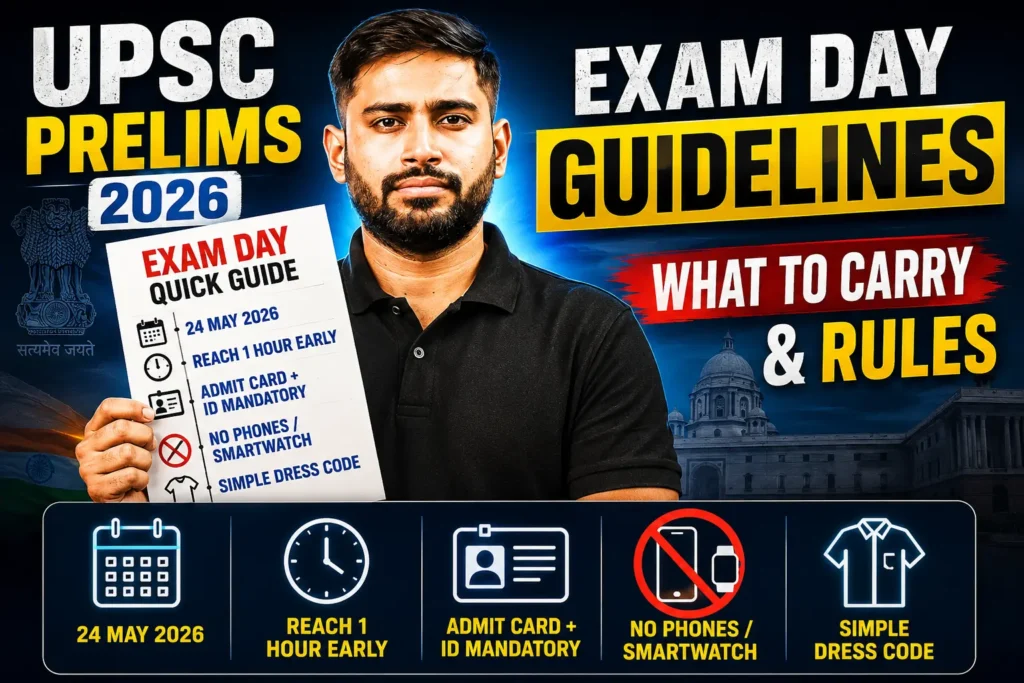
This guide covers everything you need to know about exam day, from what to carry and what to leave at home, to the dress code, entry process, and reporting time. Read it carefully at least two days before the exam so you have time to arrange anything you might be missing.
UPSC Prelims 2026 Exam Day Guidelines: Complete Overview
The UPSC Prelims is a national-level examination conducted by the Union Public Service Commission. It is the first stage of the Civil Services Examination, which eventually leads to postings in the IAS, IPS, IFS, and other central services. To understand how marks are calculated across both papers, you can use the UPSC Marks Calculator on SD Research World.
The exam is held in two papers on the same day, both objective type. Paper I is General Studies and Paper II is the CSAT. For a full breakdown of the exam structure, marks, and patterns, read our detailed guide on UPSC Exam Pattern 2026.
Because this is a high-security examination conducted simultaneously across hundreds of centres in India, UPSC has a strict set of rules for candidates. These rules are non-negotiable. Centre superintendents have the authority to disallow entry or cancel a candidate’s session if any rule is violated. So understanding the guidelines is not just helpful, it is necessary.
UPSC Prelims 2026 Documents Required: Admit Card & ID Proof
Two documents are mandatory to enter the UPSC exam centre. No exceptions.
1. UPSC Admit Card (e-Admit Card): Download it from upsc.gov.in. Print it clearly on A4 paper. Blurry or partial prints may cause problems at the gate. Your photo, roll number, exam centre details, and session timings are all on this card. Carry it to both sessions.
2. Original Photo Identity Proof: You must carry one valid government-issued ID in original, not a photocopy. Accepted IDs include:
- Aadhaar Card
- Passport
- Voter ID (EPIC Card)
- PAN Card
- Driving Licence
- Service Identity Card issued by a Central or State Government department
The name on your ID must match the name on your admit card exactly. A mismatch, even a small spelling difference, can lead to trouble at the verification stage. If you recently changed your name, carry supporting legal documents as well.
Tip: Print at least two copies of your admit card. Keep one in your bag and one separately so you have a backup.
UPSC Prelims 2026 Allowed Items List: Exam Hall Mein Kya Le Jayen?
Only a limited set of items is allowed inside the exam hall. Everything else must be left outside or at home. Here is what you can carry:
| Item | Ready? |
|---|---|
| Admit Card Printed | ☐ |
| Aadhaar Card | ☐ |
| Passport Photos | ☐ |
| Pen | ☐ |
| Water Bottle | ☐ |
| Route Planned | ☐ |
| Phone Removed | ☐ |
- Admit card (printed, not on phone)
- Original photo ID as listed above
- Passport-size photographs (carry 2 to 3 extra, as some centres ask for them during registration)
- Blue or black ballpoint pen for signing the attendance sheet
- Transparent water bottle without any label or printed text on it
- Basic stationery such as a pencil if the centre allows, though in most cases UPSC provides required materials
UPSC provides the OMR sheet and rough sheets at the centre. You do not need to carry your own answer papers. If a centre allows a specific additional item, it will be mentioned in your admit card or centre-level instructions. Always read your admit card carefully for any centre-specific notes.
Regarding food and snacks: UPSC has not officially listed packed food as a banned item, but most centres do not allow it inside the exam hall itself. You can keep it in your bag outside the hall. Do not assume you can eat inside the exam room.
UPSC Prelims 2026 Banned Items: What Not to Carry
Carrying any banned item can lead to immediate disqualification. Do not take a chance, even accidentally. The following items are strictly not allowed inside UPSC exam centres:
| Allowed | Banned |
|---|---|
| Admit Card | Mobile Phone |
| Aadhaar Card | Smartwatch |
| Ball Pen | Calculator |
| Transparent Bottle | Bluetooth Device |
| Passport Photos | Notes/Papers |
- Mobile phones of any kind, including basic keypad phones
- Smartwatches, fitness bands, or any wearable electronic device
- Bluetooth devices, earphones, or wireless earbuds
- Calculators, including scientific and pocket calculators
- Bags, backpacks, or handbags inside the exam hall (only admitted outside or in a cloak room)
- Any written material, books, notes, or printed paper other than your admit card
- Digital watches with computing or communication features
- Camera, voice recorder, or any hidden electronic device
- Wallet chains, large metal jewellery, or accessories that trigger metal detectors
This applies to all sessions, both Paper I in the morning and Paper II in the afternoon. Even if you have used a smartwatch harmlessly in daily life, leave it at home on exam day. The security checks are thorough and centre staff will not make exceptions.
A common mistake: many candidates forget to remove smartwatches because they have become a habit. Keep your watch on the table the night before as a reminder to leave it behind.
UPSC Prelims Dress Code 2026: What to Wear on Exam Day
UPSC does not prescribe a specific dress code with colours or styles. However, there are practical and security-related guidelines that every candidate should follow.
| Recommended | Avoid |
|---|---|
| Simple Shirt/T-shirt | Heavy Jacket |
| Flat Sandals | Thick Shoes |
| Minimal Accessories | Metallic Jewellery |
Wear simple, comfortable clothing. Avoid anything with large metal accessories, metal buttons, or heavy embroidery. Metal triggers security scanners and slows down the frisking process, which is inconvenient for you and others in the queue.
Footwear should be simple, such as sandals or flat shoes. Candidates wearing high-heeled footwear or shoes with thick soles may be asked to remove them for inspection during the security check.
Religious attire such as turbans, hijabs, or other head coverings is permitted. However, candidates wearing such attire may be asked to step aside for a brief secondary check. This is a standard procedure and does not imply suspicion.
Practical advice: Dress as if you are going to a formal interview, simple, neat, and without unnecessary accessories. Avoid carrying a heavy jacket or coat unless the weather genuinely demands it.
UPSC Prelims Reporting Time 2026: When to Reach the Centre
UPSC is firm about gate closure timings. The entry gates are closed 10 minutes before the exam begins. After that, no candidate is allowed in, regardless of the reason for the delay.
Paper I (General Studies): Exam begins at 9:30 AM. Gates close at 9:20 AM. Reach by 8:30 AM to complete document verification and frisking without rushing.
Paper II (CSAT): Exam begins at 2:30 PM. Gates close at 2:20 PM. Reach by 1:30 PM for the same reason.
These timings are standard and have been consistent across recent years. However, always check your admit card for centre-specific timings, as minor variations can occur.
Reaching early also gives you time to locate your seating arrangement inside the hall, use the washroom, and settle down mentally before the exam begins. Rushing into the hall at the last minute is one of the worst ways to start a high-stakes exam. Travel the route to your exam centre the day before if it is in an unfamiliar area.
UPSC Exam Centre Rules 2026: Entry Process & Security Check
The entry process at UPSC exam centres involves multiple stages. Understanding what happens at each stage helps you move through it calmly.
Stage 1: Document Verification at the Gate. Show your printed admit card and original photo ID. A security or administrative staff member will check both. If both are in order, you will be given entry to the premises.
Stage 2: Frisking and Metal Detection. Male and female candidates are frisked separately by staff of the same gender. A handheld metal detector is used. Items that trigger the detector must be removed and kept outside. Do not carry anything metallic that is not essential.
Stage 3: Seating Allocation and Attendance. Inside the hall, invigilators will guide you to your assigned seat. Your roll number and seat number will be on your admit card. An attendance sheet will be circulated, and you will need to sign it and affix a passport-size photograph in some cases.
Stage 4: Biometric Verification. UPSC conducts biometric registration at some centres as a standard anti-impersonation measure. Cooperate calmly with the invigilator during this process.
Once you are seated, do not leave your seat without permission. Any communication between candidates during the exam, even whispering, is treated as malpractice.
UPSC Prelims Exam Day Checklist: Last-Minute Tips for First-Time Candidates
If this is your first time appearing in UPSC Prelims, the exam centre experience can feel unfamiliar. Use this checklist the night before:
- Print admit card (two copies)
- Keep original photo ID ready (Aadhaar, Passport, or Voter ID)
- Carry 2 to 3 passport-size photos
- Keep a blue or black ballpoint pen in your pocket
- Keep a transparent, label-free water bottle ready
- Charge nothing electronic that you plan to carry, because no electronic items are allowed inside
- Plan your travel route and leave at least 90 minutes early
- Leave your phone, smartwatch, and earphones at home or securely in the vehicle
On the morning of the exam, eat a light meal that keeps you energised without making you feel heavy or drowsy. Avoid caffeinated drinks in excess if they make you anxious. Drink water, and rest your eyes briefly before the session begins.
If you are still in the process of building your preparation strategy for Prelims, read our detailed breakdown of the best mock test series for UPSC 2026 to understand how to use practice tests effectively in the final stretch.
First-time candidates often worry about the environment inside the hall. It is usually quiet, supervised, and well-organised. The invigilators are there to run the process, not to intimidate. Focus on your preparation and trust the work you have put in.
UPSC Prelims 2026 Important Instructions: COVID Rules & Biometric Guidelines
As of 2026, there are no active pandemic-related restrictions mandated by UPSC for the Preliminary Examination. Candidates are not required to carry COVID vaccination certificates or wear masks as a UPSC-specific rule. However, if a candidate is unwell on exam day, it is advisable to carry a basic mask for personal comfort.
Regarding biometric guidelines, UPSC uses fingerprint scanning and live photograph capture at select exam centres. This process is done before the exam begins and during the mid-exam break between Paper I and Paper II at some venues.
What to do during biometric registration: Stay calm, keep your fingers dry and clean, and do not apply hand cream or lotion on exam day morning as it can interfere with fingerprint scanning.
UPSC also photographs candidates at some centres using a digital camera. You are required to face the camera clearly and remove anything that covers your face. This is part of UPSC’s anti-impersonation protocol and is entirely standard.
If a centre has specific health-related instructions issued by local authorities at the time of the exam, those will be communicated through the admit card or through an official notice on the UPSC official website.
What to Do If You Forget Something: Emergency Help at UPSC Exam Centres
Mistakes happen, even to well-prepared candidates. Here is what you can do in a few common emergency situations.
Forgot your admit card: Go to the UPSC website on your phone before you reach the centre and download your e-Admit Card. Most convenience stores or print shops near exam centres can print it for you. Do not reach the centre without a physical copy, as digital copies on phones are not accepted inside.
Forgot your ID proof: If you have lost your original ID, a temporary government-issued identity document or an attested photocopy may be considered in rare cases, at the discretion of the centre superintendent. Call the contact number on your admit card as soon as possible for guidance.
Accidentally carried a banned item: Declare it at the gate before entering. Most centres have a deposit facility or security desk where you can leave items like phones or wallets outside. Entering with a banned item and being caught later is far worse than declaring it honestly at the entrance.
Your pen stops working during the exam: Raise your hand and inform the invigilator. They will assist you. Do not borrow from a fellow candidate, as that can be treated as a violation.
If you are planning your next steps after Prelims, you may find it useful to read our guide on UPSC Mains answer writing strategy to understand what comes next and how to prepare for it from now.
Stay calm in any of these situations. The staff at UPSC exam centres follow guidelines, and they are trained to handle common issues. Panicking wastes time and energy that you need for the actual exam.
Frequently Asked Questions
Q1. UPSC exam hall me kya le jaye? (Complete allowed items list for Prelims 2026)
You can carry your printed admit card, original photo ID, two to three passport-size photographs, a ballpoint pen, and a transparent water bottle without any label. All electronic items including mobile phones, smartwatches, and calculators are strictly banned.
Q2. What documents are required for UPSC Prelims 2026?
Two documents are mandatory: your printed UPSC e-Admit Card and one original government-issued photo ID such as Aadhaar, Passport, Voter ID, PAN Card, or Driving Licence. Both must be carried to every session.
Q3. Is there a dress code for UPSC Prelims 2026?
There is no colour-specific dress code. Wear simple, comfortable clothing without large metal accessories or thick embroidery. Avoid metal buttons or heavy footwear. Religious attire is permitted. Dress neatly and avoid anything that might slow down the security screening process.
Q4. What is the reporting time for UPSC Prelims 2026 exam centres?
For Paper I (starting at 9:30 AM), reach by 8:30 AM. For Paper II (starting at 2:30 PM), reach by 1:30 PM. The entry gate closes 10 minutes before the exam starts and late entry is not permitted under any circumstance.
Q5. Which items are banned in UPSC Prelims 2026?
Banned items include mobile phones, smartwatches, Bluetooth devices, earphones, calculators, bags inside the hall, any written material other than the admit card, digital watches with computation features, cameras, and voice recorders. Any metallic accessory that triggers the security scanner will also be flagged.
Q6. Can I carry a water bottle and snacks to the UPSC exam hall?
A transparent water bottle without any label is allowed. Snacks are generally not permitted inside the exam hall. You may keep food in your bag outside the hall during the break between sessions. Do not assume centre-specific rules; always check your admit card for any special instructions.
Q7. What should first-time UPSC candidates know before entering the exam centre in 2026?
First-time candidates should arrive at least 60 to 90 minutes early. Carry your admit card, ID, photographs, and pen. Dress simply. Avoid all banned electronic items. Cooperate calmly with document checks, frisking, and biometric registration. The process is standardised and the staff are there to help, not to intimidate. Read your admit card completely at least two days before the exam.
 Alok
Alok